CJ Begins Working at the Hospice
A Dog's JourneyCJ Begins Working at the Hospice is a turn from her long-established counseling practice toward care for people facing illness and death. She asks to volunteer with hospice counseling even as dialysis and her mother Gloria’s decline shape her own life. The change becomes more than a new role: CJ and Toby spend their days accompanying patients and families, and the work gives Toby a place in the care CJ offers.
The Request and Its Conditions
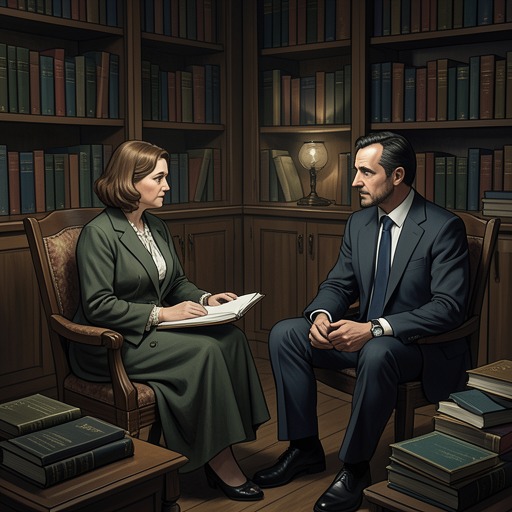
CJ raises the possibility over lunch in the courtyard with Fran, her friend and a hospice worker. She warns Fran to think before answering, prompting Fran to joke that the opening sounds like a marriage proposal. CJ clarifies that she wants to work at the hospice in counseling and volunteer, because she sees how difficult it is for Fran, Patsy, and their colleagues to keep up. She says she does not need the money.
The offer reflects a change already under way in CJ’s professional life. She has been winding down her practice and now works only as a consultant. She also explains that she finds it increasingly difficult to relate to teenagers: when she tells them that she understands what they are experiencing, she sees their skepticism, because to them there is little difference between someone in her seventies and someone a hundred years old. Hospice work would place her experience in a different setting, alongside people and families confronting illness directly.
Fran identifies an institutional obstacle: the hospice normally discourages family members from volunteering until a year after their relative has died. CJ knows the rule and asks Fran to consider an exception. She says she knows what it is like to lie in bed feeling horrible because she goes through it three times a week, and that what she is experiencing with Gloria gives her insight into how families feel. When Fran asks about her mother, CJ answers that it will not be much longer. Her application thus arises amid both personal physical hardship and the impending loss of a parent, rather than from distance from the hospice’s work.
Returning to the Hospice
Toby’s account shows CJ entering the hospice again after an interval. On a windy day among the brown leaves, he is unsure at first whether the limping woman approaching the building is his girl. Her bulky coat hides how frail and thin she has become; her familiar scent settles his uncertainty. He runs to her but is careful not to jump, afraid he might knock her over. Fran embraces CJ, who puts some things on a desk in one of the rooms.
From that day, their ordinary schedule reverses. CJ leaves at night and does not return until morning, rather than leaving in the morning and coming back at night. Toby can smell that she still goes regularly to the room with the couches, but she does not take him there. The change marks a practical reordering of their shared life around her hospice work without suggesting that Toby accompanies her into every part of it.
Counseling as Presence
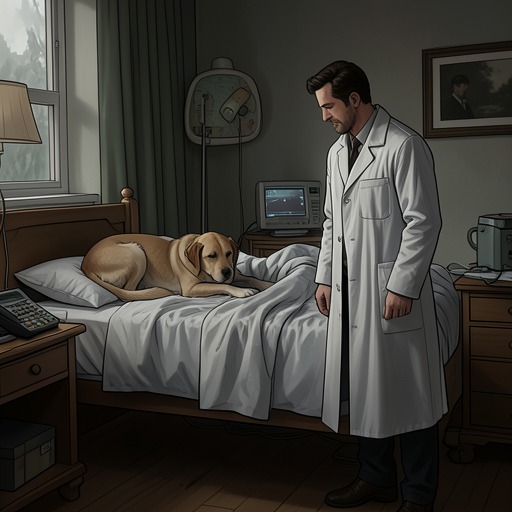
CJ moves through the building visiting patients in their rooms, talking with them and sometimes hugging them. Toby follows close at her heels. When she leaves for the night, someone often needs him beside their bed, and family members sometimes hold him. The work is therefore shown as a partnership of distinct kinds: CJ speaks with patients, while Toby stays physically present with them and their relatives.
Toby senses that people are often in pain while speaking with CJ, whether they are in bed or standing beside it. After a quiet conversation, he can feel their pain lessen a little. When family members reach for him, he understands his task as allowing them to hug him for as long and as tightly as they need, even when the embrace makes him uncomfortable. The details make comfort a practice rather than an abstract intention: conversation, a bedside presence, and a dog’s willingness to be held.
CJ calls him a good dog, as do Fran and Patsy. The praise connects Toby’s hospice role to his learned ability to be still around people who are hurting. He understands that patients may have pain and that climbing on them to play could injure them; after once stepping on a patient’s stomach and hearing his sharp cry, he learns to approach beds carefully. His work is not simply to accompany CJ, but to adapt his own behavior to the needs of the people there.
The Work’s Personal Meaning
CJ’s commitment to hospice care continues alongside her own decline. Later, while feeding Toby pieces of a ham-and-cheese sandwich, she tells him that she will be leaving and that she does not want to prolong a life whose good things she has had and whose coming hardships she would rather not face. She wants to be with her husband. Her only regret is leaving her friends, and she counts Toby among them. She asks him to be with her in her final moments so that she will not be afraid, calling him her forever friend.
Fran sits with CJ through her last day, while Toby rests with his head on CJ’s chest and her hand strokes his fur. When that hand stops moving, Fran takes it, and CJ dies with Toby beside her. This later ending does not erase the hospice work’s practical limits or CJ’s illness; instead, it brings the care she had offered patients into her own final hours. Toby’s presence, first part of the work she undertook with Fran, becomes the companionship CJ asks for when she can no longer continue it herself.